BCBA 6th Edition Test Content Outline: Complete Domain-by-Domain Breakdown (2025-2026)
9/25/2026
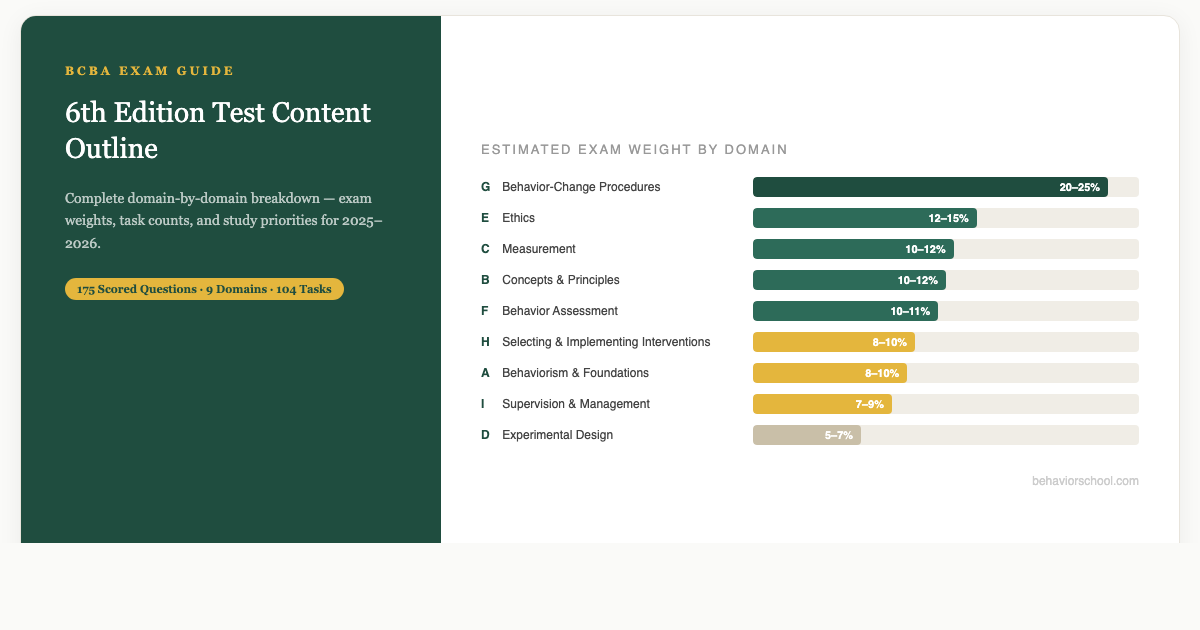
Master the BCBA 6th Edition Test Content Outline with this complete breakdown of all 9 domains, exam weights, task counts, and what changed from the 5th edition.
AI-assisted draft; reviewed and edited by Rob Spain, BCBA, IBA. All exam structure information is sourced directly from the BACB's published BCBA Test Content Outline (6th ed.), available at bacb.com. Domain question counts and percentages come from the BACB's published BCBA Test Content Outline (6th ed.).
If you're preparing for the BCBA exam, you're studying the 6th Edition Test Content Outline (TCO) - and knowing exactly what's on it, how it's weighted, and which domains eat the most exam questions is the difference between a focused study plan and wasted hours.
This guide breaks down every domain of the BCBA 6th Edition TCO, gives you the exam weights, tells you which tasks are highest-yield, and flags which sections catch school-based BCBAs off guard.
Download the official source: BCBA Test Content Outline (6th ed.) - free PDF directly from BACB.
Quick fact: The BCBA exam contains 175 scored questions plus 10 unscored pilot questions (185 total). The 6th Edition TCO organizes those questions across 9 domains with 104 total tasks. For the complete count, timing, and domain table, see How Many Questions Are on the BCBA Exam?.
What Changed from the 5th Edition Task List?
The BCBA Test Content Outline (6th ed.), published in 2022, replaced the BCBA Task List (5th ed.) as the basis for BCBA exams on January 1, 2025. Here's what's different:
- Same 9 domains, retitled and rebalanced: The 5th edition also had 9 content areas (A to I). The BACB kept all 9, retitled 2 (Philosophical Underpinnings became Behaviorism and Philosophical Foundations; Ethics became Ethical and Professional Issues), and grew from 92 to 104 tasks.
- Diversity, equity, and inclusion content integrated: The BACB integrated this content into 8 tasks across 4 domains, for example F.2 (Identify and integrate relevant cultural variables in the assessment process) and I.3 (Identify and implement methods that promote equity in supervision practices). Domain I is Personnel Supervision and Management, which was also in the 5th edition.
- Ethics restructured: Domain E, retitled Ethical and Professional Issues, now has 12 specific tasks instead of references to the entire Ethics Code.
- "Foundational" vs. "Applied" structure: The 6th edition distinguishes between conceptual foundations (early domains) and applied practice (later domains).
For a detailed comparison of 5th vs. 6th edition structure, see the BACB's published TCO at bacb.com.
The 9 Domains of the BCBA 6th Edition TCO
The BACB publishes the number of questions and the share of the exam for each domain. Here is the official breakdown (175 scored questions, 104 tasks):
Domain A: Behaviorism and Philosophical Foundations
Task count: 5 tasks | Questions: 8 (5%)
This domain covers the philosophical and theoretical bedrock of behavior analysis - the "why" behind the science.
Key tasks include:
- Identify the goals of behavior analysis as a science (i.e., description, prediction, control).
- Explain the philosophical assumptions underlying the science of behavior analysis (e.g., selectionism, determinism, empiricism, parsimony, pragmatism).
- Explain behavior from the perspective of radical behaviorism.
- Distinguish among behaviorism, the experimental analysis of behavior, applied behavior analysis, and professional practice guided by the science of behavior analysis.
- Identify and describe dimensions of applied behavior analysis.
School BCBA angle: When writing behavioral definitions in IEPs or FBAs, this domain reminds you why observable/measurable behavior is required - not "bad attitude" or "ADHD moment."
Domain B: Concepts and Principles
Task count: 24 tasks | Questions: 24 (14%)
The largest conceptual domain - this is where reinforcement, punishment, extinction, and related principles live.
Key tasks include:
- Identify and distinguish among behavior, response, and response class.
- Identify and distinguish between stimulus and stimulus class.
- Identify and distinguish between respondent and operant conditioning.
- Identify and distinguish between positive and negative reinforcement contingencies.
- Identify and distinguish between positive and negative punishment contingencies.
- Identify and distinguish between automatic and socially mediated contingencies.
- Identify and distinguish among unconditioned, conditioned, and generalized reinforcers.
- Identify and distinguish among unconditioned, conditioned, and generalized punishers.
- Identify and distinguish among simple schedules of reinforcement.
- Identify and distinguish among concurrent, multiple, mixed, and chained schedules of reinforcement.
- Identify and distinguish between operant and respondent extinction as operations and processes.
- Identify examples of stimulus control.
- Identify examples of stimulus discrimination.
- Identify and distinguish between stimulus and response generalization.
- Identify examples of response maintenance.
- Identify examples of motivating operations.
- Distinguish between motivating operations and stimulus control.
- Identify and distinguish between rule-governed and contingency-shaped behavior.
- Identify and distinguish among verbal operants.
- Identify the role of multiple control in verbal behavior.
- Identify ways behavioral momentum can be used to understand response persistence.
- Identify ways the matching law can be used to interpret response allocation.
- Identify and distinguish between imitation and observational learning.
- Identify examples of processes that promote emergent relations and generative performance.
High-yield: Schedules of reinforcement (VI, VR, FI, FR) and their characteristic response patterns come up consistently in candidate reports. Know the scallop pattern, the post-reinforcement pause, and which schedules are most resistant to extinction.
Domain C: Measurement, Data Display, and Interpretation
Task count: 12 tasks | Questions: 21 (12%)
Measurement is one of the most applied domains and often underestimated by candidates. This is where data systems live.
Key tasks include:
- Create operational definitions of behavior.
- Distinguish among direct, indirect, and product measures of behavior.
- Measure occurrence.
- Measure temporal dimensions of behavior (e.g., duration, latency, interresponse time).
- Distinguish between continuous and discontinuous measurement procedures.
- Design and apply discontinuous measurement procedures (e.g., interval recording, time sampling).
- Measure efficiency (e.g., trials to criterion, cost-benefit analysis, training duration).
- Evaluate the validity and reliability of measurement procedures.
- Select a measurement procedure to obtain representative data that accounts for the critical dimension of the behavior and environmental constraints.
- Graph data to communicate relevant quantitative relations (e.g., equal-interval graphs, bar graphs, cumulative records).
- Interpret graphed data.
- Select a measurement procedure to obtain representative procedural integrity data that accounts for relevant dimensions (e.g., accuracy, dosage) and environmental constraints.
School BCBA angle: Data sheets, ABC recording, scatter plots, frequency counts for IEP goals - all of this anchors in Domain C. If you're building your exam prep, measurement should be a priority; it's both testable and immediately applicable.
Domain D: Experimental Design
Task count: 9 tasks | Questions: 13 (7%)
Fewer questions than most domains, but it requires conceptual precision. This covers single-case design, internal validity, and research interpretation.
Key tasks include:
- Distinguish between dependent and independent variables.
- Distinguish between internal and external validity.
- Identify threats to internal validity (e.g., history, maturation).
- Identify the defining features of single-case experimental designs (e.g., individuals serve as their own controls, repeated measures, prediction, verification, replication).
- Identify the relative strengths of single-case experimental designs and group designs.
- Critique and interpret data from single-case experimental designs.
- Distinguish among reversal, multiple-baseline, multielement, and changing-criterion designs.
- Identify rationales for conducting comparative, component, and parametric analyses.
- Apply single-case experimental designs.
What to know: Expect scenario questions such as: "A researcher wants to minimize carryover effects. Which design is most appropriate?"
Domain E: Ethical and Professional Issues
Task count: 12 tasks | Questions: 22 (13%)
Ethical and Professional Issues has 12 tasks and 22 questions (13%), up from 18 questions (10%) in the 5th edition. Do not underweight this.
Key tasks include:
- Identify and apply core principles underlying the ethics codes for BACB certificants (e.g., benefit others; treat others with compassion, dignity, and respect; behave with integrity).
- Identify the risks to oneself, others, and the profession as a result of engaging in unethical behavior.
- Develop and maintain competence by engaging in professional development activities (e.g., read literature, seek consultation, establish mentors).
- Identify and comply with requirements for collecting, using, protecting, and disclosing confidential information.
- Identify and comply with requirements for making public statements about professional activities (e.g., social media activity; misrepresentation of professional credentials, behavior analysis, and service outcomes).
- Identify the conditions under which services or supervision should be discontinued and apply steps that should be taken when transitioning clients and supervisees to another professional.
- Identify types of and risks associated with multiple relationships, and how to mitigate those risks when they are unavoidable.
- Identify and apply interpersonal and other skills (e.g., accepting feedback, listening actively, seeking input, collaborating) to establish and maintain professional relationships.
- Engage in cultural humility in service delivery and professional relationships.
- Apply culturally responsive and inclusive service and supervision activities.
- Identify personal biases and how they might interfere with professional activity.
- Identify and apply the legal, regulatory, and practice requirements (e.g., licensure, jurisprudence, funding, certification) relevant to the delivery of behavior-analytic services.
Top traps:
- Multiple relationships: know the risks and how to mitigate them when they are unavoidable
- Confidentiality: know the requirements for collecting, using, protecting, and disclosing information
- Discontinuing services: know the steps for transitioning clients and supervisees
Domain F: Behavior Assessment
Task count: 8 tasks | Questions: 23 (13%)
This is where FBAs, preference assessments, and skill assessments live. Extremely applied, high relevance for school BCBAs.
Key tasks include:
- Identify relevant sources of information in records (e.g., educational, medical, historical) at the outset of the case.
- Identify and integrate relevant cultural variables in the assessment process.
- Design and evaluate assessments of relevant skill strengths and areas of need.
- Design and evaluate preference assessments.
- Design and evaluate descriptive assessments.
- Design and evaluate functional analyses.
- Interpret assessment data to determine the need for behavior-analytic services and/or referral to others.
- Interpret assessment data to identify and prioritize socially significant, client-informed, and culturally responsive behavior-change procedures and goals.
School BCBA angle: The FBA → function → BIP chain is your daily workflow. This domain directly transfers to practice. If you're a working school BCBA, you have an advantage here - use it.
Domain G: Behavior-Change Procedures
Task count: 19 tasks | Questions: 25 (14%)
The largest domain by question count: 25 questions (14%), one more than Concepts and Principles. Its 19 tasks are second only to Domain B's 24.
Key tasks include:
- Design and evaluate positive and negative reinforcement procedures.
- Design and evaluate differential reinforcement (e.g., DRA, DRO, DRL, DRH) procedures with and without extinction.
- Design and evaluate time-based reinforcement (e.g., fixed-time) schedules.
- Identify procedures to establish and use conditioned reinforcers (e.g., token economies).
- Incorporate motivating operations and discriminative stimuli into behavior-change procedures.
- Design and evaluate procedures to produce simple and conditional discriminations.
- Select and evaluate stimulus and response prompting procedures (e.g., errorless, most-to-least, least-to-most).
- Design and implement procedures to fade stimulus and response prompts (e.g., prompt delay, stimulus fading).
- Design and evaluate modeling procedures.
- Design and evaluate instructions and rules.
- Shape dimensions of behavior.
- Select and implement chaining procedures.
- Design and evaluate trial-based and free-operant procedures.
- Design and evaluate group contingencies.
- Design and evaluate procedures to promote stimulus and response generalization.
- Design and evaluate procedures to maintain desired behavior change following intervention (e.g., schedule thinning, transferring to naturally occurring reinforcers).
- Design and evaluate positive and negative punishment (e.g., time-out, response cost, overcorrection).
- Evaluate emotional and elicited effects of behavior-change procedures.
- Design and evaluate procedures to promote emergent relations and generative performance.
Study strategy: This domain has the most exam questions (25). Learn procedures within the function-based framework. "The behavior serves escape - which procedure directly addresses that?" Practice linking function → intervention choice.
High-yield for school BCBAs: FCT, DRA/DRI for function-based intervention, prompt hierarchies, and generalization programming.
Domain H: Selecting and Implementing Interventions
Task count: 8 tasks | Questions: 20 (11%)
This domain bridges assessment to practice - how you select, plan, and implement behavior support.
Key tasks include:
- Develop intervention goals in observable and measurable terms.
- Identify and recommend interventions based on assessment results, scientific evidence, client preferences, and contextual fit (e.g., expertise required for implementation, cultural variables, environmental resources).
- Select socially valid alternative behavior to be established or increased when a target behavior is to be decreased.
- Plan for and attempt to mitigate possible unwanted effects when using reinforcement, extinction, and punishment procedures.
- Plan for and attempt to mitigate possible relapse of the target behavior.
- Make data-based decisions about procedural integrity.
- Make data-based decisions about the effectiveness of the intervention and the need for modification.
- Collaborate with others to support and enhance client services.
School BCBA angle: Collaborating with teachers, adapting for classroom contexts, and fitting behavior support into MTSS/PBIS tiers - this domain is your daily work. Candidates with school experience often find this domain intuitive.
Domain I: Personnel Supervision and Management
Task count: 7 tasks | Questions: 19 (11%)
Domain I has 19 questions (11%) in the 6th edition, up from 17 (10%) in the 5th. This domain covers how BCBAs train, supervise, and support RBTs and other behavior technicians.
Key tasks include:
- Identify the benefits of using behavior-analytic supervision (e.g., improved client outcomes, improved staff performance and retention).
- Identify and apply strategies for establishing effective supervisory relationships (e.g., executing supervisor-supervisee contracts, establishing clear expectations, giving and accepting feedback).
- Identify and implement methods that promote equity in supervision practices.
- Select supervision goals based on an assessment of the supervisee's skills, cultural variables, and the environment.
- Identify and apply empirically validated and culturally responsive performance management procedures (e.g., modeling, practice, feedback, reinforcement, task clarification, manipulation of response effort).
- Apply a function-based approach (e.g., performance diagnostics) to assess and improve supervisee behavior.
- Make data-based decisions about the efficacy of supervisory practices.
What to know: BST (instruction + modeling + rehearsal + feedback) appears across both Domain G and Domain I - know it inside and out. Also know the BACB's requirements for supervision documentation.
Domain Weights at a Glance
| Domain | Tasks | Questions (% of exam), BACB | Priority |
|---|---|---|---|
| A - Behaviorism & Philosophical Foundations | 5 | 8 (5%) | Medium |
| B - Concepts and Principles | 24 | 24 (14%) | High |
| C - Measurement, Data Display, and Interpretation | 12 | 21 (12%) | High |
| D - Experimental Design | 9 | 13 (7%) | Medium |
| E - Ethical and Professional Issues | 12 | 22 (13%) | Very High |
| F - Behavior Assessment | 8 | 23 (13%) | High |
| G - Behavior-Change Procedures | 19 | 25 (14%) | Critical |
| H - Selecting & Implementing Interventions | 8 | 20 (11%) | High |
| I - Personnel Supervision & Management | 7 | 19 (11%) | Medium |
Source: BACB, BCBA Test Content Outline (6th ed.). Every domain is tested.
Which Domains Should You Study First?
Tier 1 - Study these first (highest question counts):
- Domain G (Behavior-Change Procedures): 25 questions (14%)
- Domain B (Concepts and Principles): 24 questions (14%)
- Domain F (Behavior Assessment): 23 questions (13%)
- Domain E (Ethical and Professional Issues): 22 questions (13%)
Tier 2 - High importance, study concurrently:
- Domain C (Measurement, Data Display, and Interpretation): 21 questions (12%)
- Domain H (Selecting and Implementing Interventions): 20 questions (11%)
- Domain I (Personnel Supervision and Management): 19 questions (11%)
Tier 3 - Fewer questions, but still tested:
- Domain D (Experimental Design): 13 questions (7%)
- Domain A (Behaviorism and Philosophical Foundations): 8 questions (5%)
What This Means for School-Based BCBAs
If you work in schools, you have an advantage on the BCBA exam - and some blind spots.
Advantages:
- Domain F and Domain H mirror school-based practice
- Domain G's function-based procedures (FBA → FCT → DRA) are your daily workflow
- You see IEP goal development, team collaboration, and MTSS tiers in real life
Potential blind spots:
- Domain D (Experimental Design): school BCBAs rarely conduct single-subject research
- Domain E (Ethics): school settings create unique dual relationship and confidentiality challenges
- Domain B (Schedules of reinforcement): classroom practice is rarely as precise as the exam requires
How to Use This Breakdown in Your Study Plan
- Map your current knowledge to each domain. Take a diagnostic practice exam and score yourself by domain. Try our free BCBA practice exam - it tracks your performance by domain automatically.
- Allocate study time by weight. Domain G (25 questions) is worth about twice as many questions as Domain D (13).
- Study the Ethics Code directly. Don't rely on summaries - read the 2022 BACB Ethics Code and review its requirements in context.
- Practice IOA calculations. Measurement (Domain C) has math questions. Do them with paper before exam day.
- Do domain-specific practice questions. After studying each domain, hit practice questions targeting it specifically.
Ready to practice by domain? Behavior Study Tools generates unlimited domain-specific practice questions for the 6th Edition TCO - so you can drill Domain G until it sticks.
Practice the 6th Edition Outline With the Right Question Format
Different parts of the 6th Edition outline call for different practice formats:
- BCBA exam practice questions are best after you study a domain and need mixed examples with rationales.
- Sample BCBA exam questions are useful when you want to inspect wording, scenario structure, and distractor patterns before a longer session.
- BCBA mock exam free is the better choice when you need to test pacing and endurance across domains.
- BCBA practice exam gives you a broader exam-style practice path after you have mapped your weak domains.
Frequently Asked Questions
Is the BCBA exam still based on the 6th Edition TCO in 2026? Yes. The BCBA exam has been based on the BCBA Test Content Outline (6th ed.) since January 1, 2025, and the BACB says there are currently no upcoming changes to the exam or the outline, including with the 2027 requirement changes.
How many questions are on the BCBA exam? 185 total: 175 scored and 10 unscored pilot questions, in 4 hours. Answer every question as if it counts.
What is the passing score for the BCBA exam? The BACB sets the passing score with the modified Angoff method, and exam forms are statistically equated, so the number correct needed can vary by form. Scaled scores appear on score reports; the BACB's current pages don't publish a specific scaled passing score.
How long do I have to take the BCBA exam? 4 hours for the full exam.
What percentage of people pass the BCBA exam on the first try? In 2025, 51% of first-time BCBA candidates passed and 23% of retake candidates passed. First-time rates were 54% to 56% in 2022 to 2024 (BACB).
Summary
The BCBA Test Content Outline (6th ed.) organizes 175 scored exam questions across 9 domains and 104 tasks. Domain G (Behavior-Change Procedures) has the most questions (25, 14%), followed closely by Concepts and Principles (24, 14%), Behavior Assessment (23, 13%), and Ethical and Professional Issues (22, 13%). For school-based BCBAs, the biggest hidden risks are Domain D (Experimental Design) and Domain E (Ethics) - both require deliberate study beyond everyday practice.
Next steps:
- Take a free BCBA practice exam by domain
- Read our BCBA exam prep study strategies guide
- Explore Behavior Study Tools for domain-specific practice
Rob Spain is a Board Certified Behavior Analyst (BCBA) and International Behavior Analyst (IBA) with 25+ years of school-based practice. He is the founder of Behavior School and Behavior Study Tools.
Sources & References
- Behavior Analyst Certification Board. (2022). BCBA test content outline (6th ed.). https://www.bacb.com/wp-content/uploads/2022/01/BCBA-6th-Edition-Test-Content-Outline-240903-a.pdf
- Behavior Analyst Certification Board. (2022). Ethics Code for Behavior Analysts. BACB. https://www.bacb.com/ethics/ethics-code-for-behavior-analysts/
- Individuals with Disabilities Education Act, 20 U.S.C. § 1414 et seq. (2004).
- Behavior Analyst Certification Board. (n.d.). Examination information. https://www.bacb.com/examination-information/
Domain question counts and percentages are from the BACB's BCBA Test Content Outline (6th ed.).